
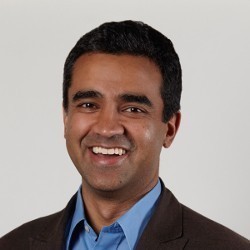
Dr. Rishi Manchanda is a physician and leader focused on reducing harm and improving health by addressing social and structural factors. As a LANES board member, he brings considerable experience and a unique perspective, one that recognizes the value of bringing together different types of data — such as healthcare, behavioral health, and social services — to improve patient outcomes.
In this conversation, Dr. Manchanda discusses how he came to coin the term “upstreamist” and what it has to do with moral injury, why he’s passionate about LANES’ work, and what he thinks about the future intersection of data sharing, technology, and healthcare in California.
Question: Can you tell us a little about your background and your unique perspective on healthcare?
I’m board-certified in internal medicine and pediatrics and trained at UCLA, where I was part of the inaugural combined residency program. I also earned a Master of Public Health degree and was a National Health Service Corps scholar, which meant I repaid my scholarship through service in under-resourced communities.
After residency, I practiced at federally qualified health centers in Los Angeles, including Venice Family Clinic and a clinic in South Central Los Angeles, where I founded a social medicine program.
That perspective guided my career. I later helped build clinics and programs for veterans experiencing homelessness at the VA in Los Angeles, and then served as Chief Medical Officer for a large agricultural employer in California’s Central Valley, where I worked to improve care for farmworkers and their families.
Through that work, I saw firsthand that health is shaped by much more than clinical care. People experience harm physically, emotionally, mentally, and socially, and many of those harms stem from upstream societal conditions. Now, I describe myself as an “upstreamist.” It’s a term I developed early in my career to describe the kind of physician and leader I wanted to be. For me, being an upstreamist means reducing harm by addressing the conditions that put people in harm’s way in the first place (watch this TED Talk to learn more).
As I gained these experiences, I realized there were many others in healthcare trying to do the same thing: not just provide downstream services, but address the upstream conditions that shape health. That realization eventually led me to found HealthBegins.
Question: Can you tell us more about the motivation behind upstreaming and HealthBegins?
One of the major issues I kept encountering in my career was moral injury. People often confuse moral injury with burnout, but they’re different. Burnout comes from being overworked. Moral injury occurs when people join a profession because of its mission, but the systems around them prevent them from fulfilling that mission.
As clinicians, we often know what patients need, but we’re unable to address the underlying social conditions affecting their health. That gap between our professional aspirations and professional reality creates a profound sense of moral injury.
To help close that gap, I founded HealthBegins in 2012 as a community of upstreamists: people working to reduce harm and improve health by addressing social and structural factors. We wanted to share lessons, identify what’s working, and help one another reclaim a sense of agency.
Over time, we began codifying the tools and approaches that were helping organizations move upstream. Then, in 2017, the Centers for Medicare & Medicaid Services launched the Accountable Health Communities Model. HealthBegins became a major partner in that effort, and that’s when the organization transitioned into full-time work.
Today, HealthBegins works across California and the country to help organizations move upstream through integration, investment, and power-building strategies.
Question: How did you first become involved with LANES, and what led you to join the board?
The work LANES does resonates deeply because I have seen how fragmented data systems create barriers to both high-quality and equitable care. Clinical providers often struggle to share information with one another, and the challenges become even greater when trying to connect healthcare organizations with community-based organizations that address social and behavioral needs.
Without effective data-sharing infrastructure, providers are left experiencing the very moral injury I described earlier. We know what patients need, but we lack the tools and information necessary to coordinate care effectively.
LANES represented a powerful solution to that challenge. It created the infrastructure needed to collect, analyze, and share information across organizations and sectors.
Question: Looking at the healthcare landscape today, what are the biggest wins from a data perspective?
There have been several significant wins over the past decade.
First, we’ve made tremendous progress in data standardization. Thanks to efforts like the Gravity Project, we now have more consistent ways to document and exchange information related to social needs, such as housing instability and food insecurity.
Second, we’ve seen major advances in interoperability. Clinical providers and social service organizations can increasingly exchange information in meaningful ways.
Third, we’ve improved workflow integration. We now have systems that can support screening, referrals, and closed-loop referral processes, helping organizations coordinate care more effectively.
Together, these advances form what I call equity infrastructure. Data infrastructure is essential to achieving health equity because it helps us understand where needs exist and where resources should be directed. LANES is a great example of this kind of infrastructure.
Question: What are some of the biggest challenges?
The first is that many of our data systems are still shaped by fee-for-service economics. Healthcare is trying to move toward value-based care, but the gravitational pull of fee-for-service remains strong. Unfortunately, we’re also beginning to impose those same dynamics on community-based organizations that provide housing, food, transportation, and other supports.
As a result, community organizations are increasingly being asked to document, code, and bill in ways that mirror healthcare’s administrative burdens. We risk recreating the same challenges that electronic medical records software — at least the ones built for fee-for-service billing — introduced for clinicians.
The second challenge is that we have a sea of data but a desert of insight. We have more information than ever before, but not enough systems that help people make sense of it. The next phase of innovation must focus on human-centered design and delivering better insights—not simply more data.
The third challenge is artificial intelligence. AI is advancing faster than many of our systems are prepared for. The critical question is whether AI will become another mechanism for extracting value from people’s data, or whether it will help us improve population health and strengthen communities. That’s ultimately an economic and ethical question as much as a technological one, and it’s a conversation we need to be having much more actively.
Question: What do you think health, behavioral health, and social services organizations should know about LANES?
I would ask them a simple question: Do you want to provide care with one hand tied behind your back, or would you rather use both hands?
When organizations rely only on the information available within their own walls, they’re missing much of the story. They don’t know what services a patient may have received elsewhere, what needs have already been identified, or what resources may already be available to help. Without integrated data-sharing infrastructure, providers are forced to operate with an incomplete picture.
LANES helps untie that second hand.
It’s not just data infrastructure — it’s care infrastructure. It enables providers, health systems, public health agencies, and community organizations to work as part of a connected ecosystem rather than as isolated entities. Most importantly, it reminds us that we’re not doing this work alone. We’re part of a broader community of organizations working together to improve health. LANES helps connect that community and unlock its collective potential.
Meet the rest of the LANES board.